Downloads
A Enhancing student academic performance prediction through feature selection techniques and machine learning algorithms
Authors
Abstract
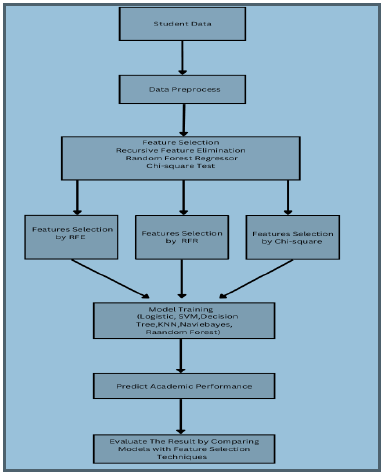
Student academic performance evaluates the level of achievement a student attains in their educational tasks. It is used to identify strengths, weaknesses, and trends in learning. Performance is often measured through grades, test scores, and overall participation in academic activities. High performance signifies strong comprehension and active engagement, whereas lower performance can highlight potential challenges or areas needing support. This evaluation plays a important role in designing personalized learning strategies. A dataset with 33 features has been utilized to analyse student performance. These features include demographic information (such as age, gender, and family background), academic results, and personal and social variables like family relationships, free time, health status, and alcohol consumption. To identify the most significant factors influencing performance, feature selection techniques such as Recursive Feature Elimination (RFE), Random Forest Regressor, and Chi-square were applied. Among these, the Random Forest Regressor demonstrated the highest predictive performance, achieving an accuracy of up to 93.67% in models such as logistic regression.
Article Details
Published
Issue
Section
License

This work is licensed under a Creative Commons Attribution-NonCommercial-ShareAlike 4.0 International License.